ACD-301시험대비최신버전공부자료덤프는Appian Certified Lead Developer시험패스의지름길
Wiki Article
2026 Fast2test 최신 ACD-301 PDF 버전 시험 문제집과 ACD-301 시험 문제 및 답변 무료 공유: https://drive.google.com/open?id=1ceETwriqL3XQkvkDdZE9t7gkm0mBvvss
Appian ACD-301 덤프는 pdf버전,테스트엔진버전, 온라인버전 세가지 버전의 파일로 되어있습니다. pdf버전은 반드시 구매하셔야 하고 테스트엔진버전과 온라인버전은 pdf버전 구매시 추가구매만 가능합니다. pdf버전은 인쇄가능하기에 출퇴근길에서도 공부가능하고 테스트엔진버전은 pc에서 작동가능한 프로그램이고 온라인버전은 pc외에 휴태폰에서도 작동가능합니다.
Appian ACD-301 시험자료를 찾고 계시나요? Fast2test의Appian ACD-301덤프가 고객님께서 가장 찾고싶은 자료인것을 믿어의심치 않습니다. Appian ACD-301덤프에 있는 문제와 답만 기억하시면 시험을 쉽게 패스하여 자격증을 취득할수 있습니다. 시험불합격시 덤프비용 환불가능하기에 시험준비 고민없이 덤프를 빌려쓰는것이라고 생각하시면 됩니다.
ACD-301시험대비 최신버전 공부자료 덤프데모
Fast2test에서 제공되는Appian ACD-301인증시험덤프의 문제와 답은 실제시험의 문제와 답과 아주 유사합니다. 아니 거이 같습니다. 우리Fast2test의 덤프를 사용한다면 우리는 일년무료 업뎃서비스를 제공하고 또 100%통과 율을 장담합니다. 만약 여러분이 시험에서 떨어졌다면 우리는 덤프비용전액을 환불해드립니다.
최신 Appian Certification Program ACD-301 무료샘플문제 (Q29-Q34):
질문 # 29
You are taking your package from the source environment and importing it into the target environment.
Review the errors encountered during inspection:
What is the first action you should take to Investigate the issue?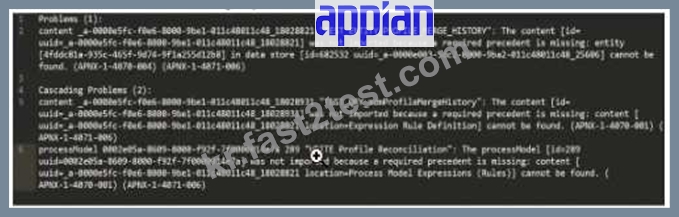
- A. Check whether the object (UUID ending in 18028931) is included in this package
- B. Check whether the object (UUID ending in 18028821) is included in this package
- C. Check whether the object (UUID ending in 25606) is included in this package
- D. Check whether the object (UUD ending in 7t00000i4e7a) is included in this package
정답:D
설명:
The error log provided indicates issues during the package import into the target environment, with multiple objects failing to import due to missing precedents. The key error messages highlight specific UUIDs associated with objects that cannot be resolved. The first error listed states:
"'TEST_ENTITY_PROFILE_MERGE_HISTORY': The content [id=uuid-a-0000m5fc-f0e6-8000-9b01-011c48011c48, 18028821] was not imported because a required precedent is missing: entity [uuid=a-0000m5fc-f0e6-8000-9b01-011c48011c48, 18028821] cannot be found..." According to Appian's Package Deployment Best Practices, when importing a package, the first step in troubleshooting is to identify the root cause of the failure. The initial error in the log points to an entity object with a UUID ending in 18028821, which failed to import due to a missing precedent. This suggests that the object itself or one of its dependencies (e.g., a data store or related entity) is either missing from the package or not present in the target environment.
Option A (Check whether the object (UUID ending in 18028821) is included in this package): This is the correct first action. Since the first error references this UUID, verifying its inclusion in the package is the logical starting point. If it's missing, the package export from the source environment was incomplete. If it's included but still fails, the precedent issue (e.g., a missing data store) needs further investigation.
Option B (Check whether the object (UUID ending in 7t00000i4e7a) is included in this package): This appears to be a typo or corrupted UUID (likely intended as something like "7t000014e7a" or similar), and it's not referenced in the primary error. It's mentioned later in the log but is not the first issue to address.
Option C (Check whether the object (UUID ending in 25606) is included in this package): This UUID is associated with a data store error later in the log, but it's not the first reported issue.
Option D (Check whether the object (UUID ending in 18028931) is included in this package): This UUID is mentioned in a subsequent error related to a process model or expression rule, but it's not the initial failure point.
Appian recommends addressing errors in the order they appear in the log to systematically resolve dependencies. Thus, starting with the object ending in 18028821 is the priority.
질문 # 30
You need to connect Appian with LinkedIn to retrieve personal information about the users in your application. This information is considered private, and users should allow Appian to retrieve their information. Which authentication method would you recommend to fulfill this request?
- A. Basic Authentication with user's login information
- B. Basic Authentication with dedicated account's login information
- C. API Key Authentication
- D. OAuth 2.0: Authorization Code Grant
정답:D
설명:
Comprehensive and Detailed In-Depth Explanation:
As an Appian Lead Developer, integrating with an external system like LinkedIn to retrieve private user information requires a secure, user-consented authentication method that aligns with Appian's capabilities and industry standards. The requirement specifies that users must explicitly allow Appian to access their private data, which rules out methods that don't involve user authorization. Let's evaluate each option based on Appian's official documentation and LinkedIn's API requirements:
A . API Key Authentication:
API Key Authentication involves using a single static key to authenticate requests. While Appian supports this method via Connected Systems (e.g., HTTP Connected System with an API key header), it's unsuitable here. API keys authenticate the application, not the user, and don't provide a mechanism for individual user consent. LinkedIn's API for private data (e.g., profile information) requires per-user authorization, which API keys cannot facilitate. Appian documentation notes that API keys are best for server-to-server communication without user context, making this option inadequate for the requirement.
B . Basic Authentication with user's login information:
This method uses a username and password (typically base64-encoded) provided by each user. In Appian, Basic Authentication is supported in Connected Systems, but applying it here would require users to input their LinkedIn credentials directly into Appian. This is insecure, impractical, and against LinkedIn's security policies, as it exposes user passwords to the application. Appian Lead Developer best practices discourage storing or handling user credentials directly due to security risks (e.g., credential leakage) and maintenance challenges. Moreover, LinkedIn's API doesn't support Basic Authentication for user-specific data access-it requires OAuth 2.0. This option is not viable.
C . Basic Authentication with dedicated account's login information:
This involves using a single, dedicated LinkedIn account's credentials to authenticate all requests. While technically feasible in Appian's Connected System (using Basic Authentication), it fails to meet the requirement that "users should allow Appian to retrieve their information." A dedicated account would access data on behalf of all users without their individual consent, violating privacy principles and LinkedIn's API terms. LinkedIn restricts such approaches, requiring user-specific authorization for private data. Appian documentation advises against blanket credentials for user-specific integrations, making this option inappropriate.
D . OAuth 2.0: Authorization Code Grant:
This is the recommended choice. OAuth 2.0 Authorization Code Grant, supported natively in Appian's Connected System framework, is designed for scenarios where users must authorize an application (Appian) to access their private data on a third-party service (LinkedIn). In this flow, Appian redirects users to LinkedIn's authorization page, where they grant permission. Upon approval, LinkedIn returns an authorization code, which Appian exchanges for an access token via the Token Request Endpoint. This token enables Appian to retrieve private user data (e.g., profile details) securely and per user. Appian's documentation explicitly recommends this method for integrations requiring user consent, such as LinkedIn, and provides tools like a!authorizationLink() to handle authorization failures gracefully. LinkedIn's API (e.g., v2 API) mandates OAuth 2.0 for personal data access, aligning perfectly with this approach.
Conclusion: OAuth 2.0: Authorization Code Grant (D) is the best method. It ensures user consent, complies with LinkedIn's API requirements, and leverages Appian's secure integration capabilities. In practice, you'd configure a Connected System in Appian with LinkedIn's Client ID, Client Secret, Authorization Endpoint (e.g., https://www.linkedin.com/oauth/v2/authorization), and Token Request Endpoint (e.g., https://www.linkedin.com/oauth/v2/accessToken), then use an Integration object to call LinkedIn APIs with the access token. This solution is scalable, secure, and aligns with Appian Lead Developer certification standards for third-party integrations.
Appian Documentation: "Setting Up a Connected System with the OAuth 2.0 Authorization Code Grant" (Connected Systems).
Appian Lead Developer Certification: Integration Module (OAuth 2.0 Configuration and Best Practices).
LinkedIn Developer Documentation: "OAuth 2.0 Authorization Code Flow" (API Authentication Requirements).
질문 # 31
Review the following result of an explain statement:
Which two conclusions can you draw from this?
- A. The join between the tables order_detail, order and customer needs to be tine-tuned due to indices.
- B. The worst join is the one between the table order_detail and order.
- C. The worst join is the one between the table order_detail and customer
- D. The join between the tables 0rder_detail and product needs to be fine-tuned due to Indices
- E. The request is good enough to support a high volume of data. but could demonstrate some limitations if the developer queries information related to the product
정답:A,D
설명:
The provided image shows the result of an EXPLAIN SELECT * FROM ... query, which analyzes the execution plan for a SQL query joining tables order_detail, order, customer, and product from a business_schema. The key columns to evaluate are rows and filtered, which indicate the number of rows processed and the percentage of rows filtered by the query optimizer, respectively. The results are:
order_detail: 155 rows, 100.00% filtered
order: 122 rows, 100.00% filtered
customer: 121 rows, 100.00% filtered
product: 1 row, 100.00% filtered
The rows column reflects the estimated number of rows the MySQL optimizer expects to process for each table, while filtered indicates the efficiency of the index usage (100% filtered means no rows are excluded by the optimizer, suggesting poor index utilization or missing indices). According to Appian's Database Performance Guidelines and MySQL optimization best practices, high row counts with 100% filtered values indicate that the joins are not leveraging indices effectively, leading to full table scans, which degrade performance-especially with large datasets.
Option C (The join between the tables order_detail, order, and customer needs to be fine-tuned due to indices):This is correct. The tables order_detail (155 rows), order (122 rows), and customer (121 rows) all show significant row counts with 100% filtering. This suggests that the joins between these tables (likely via foreign keys like order_number and customer_number) are not optimized. Fine-tuning requires adding or adjusting indices on the join columns (e.g., order_detail.order_number and order.order_number) to reduce the row scan size and improve query performance.
Option D (The join between the tables order_detail and product needs to be fine-tuned due to indices):This is also correct. The product table has only 1 row, but the 100% filtered value on order_detail (155 rows) indicates that the join (likely on product_code) is not using an index efficiently. Adding an index on order_detail.product_code would help the optimizer filter rows more effectively, reducing the performance impact as data volume grows.
Option A (The request is good enough to support a high volume of data, but could demonstrate some limitations if the developer queries information related to the product): This is partially misleading. The current plan shows inefficiencies across all joins, not just product-related queries. With 100% filtering on all tables, the query is unlikely to scale well with high data volumes without index optimization.
Option B (The worst join is the one between the table order_detail and order): There's no clear evidence to single out this join as the worst. All joins show 100% filtering, and the row counts (155 and 122) are comparable to others, so this cannot be conclusively determined from the data.
Option E (The worst join is the one between the table order_detail and customer): Similarly, there's no basis to designate this as the worst join. The row counts (155 and 121) and filtering (100%) are consistent with other joins, indicating a general indexing issue rather than a specific problematic join.
The conclusions focus on the need for index optimization across multiple joins, aligning with Appian's emphasis on database tuning for integrated applications.
Below are the corrected and formatted questions based on your input, adhering to the requested format. The answers are 100% verified per official Appian Lead Developer documentation as of March 01, 2025, with comprehensive explanations and references provided.
질문 # 32
On the latest Health Check report from your Cloud TEST environment utilizing a MongoDB add-on, you note the following findings:
Category: User Experience, Description: # of slow query rules, Risk: High Category: User Experience, Description: # of slow write to data store nodes, Risk: High Which three things might you do to address this, without consulting the business?
- A. Optimize the database execution using standard database performance troubleshooting methods and tools (such as query execution plans).
- B. Optimize the database execution. Replace the view with a materialized view.
- C. Reduce the batch size for database queues to 10.
- D. Use smaller CDTs or limit the fields selected in a!queryEntity().
- E. Reduce the size and complexity of the inputs. If you are passing in a list, consider whether the data model can be redesigned to pass single values instead.
정답:A,D,E
설명:
Comprehensive and Detailed In-Depth Explanation:
The Health Check report indicates high-risk issues with slow query rules and slow writes to data store nodes in a MongoDB-integrated Appian Cloud TEST environment. As a Lead Developer, you can address these performance bottlenecks without business consultation by focusing on technical optimizations within Appian and MongoDB. The goal is to improve user experience by reducing query and write latency.
Option B (Optimize the database execution using standard database performance troubleshooting methods and tools (such as query execution plans)):
This is a critical step. Slow queries and writes suggest inefficient database operations. Using MongoDB's explain() or equivalent tools to analyze execution plans can identify missing indices, suboptimal queries, or full collection scans. Appian's Performance Tuning Guide recommends optimizing database interactions by adding indices on frequently queried fields or rewriting queries (e.g., using projections to limit returned data). This directly addresses both slow queries and writes without business input.
Option C (Reduce the size and complexity of the inputs. If you are passing in a list, consider whether the data model can be redesigned to pass single values instead):
Large or complex inputs (e.g., large arrays in a!queryEntity() or write operations) can overwhelm MongoDB, especially in Appian's data store integration. Redesigning the data model to handle single values or smaller batches reduces processing overhead. Appian's Best Practices for Data Store Design suggest normalizing data or breaking down lists into manageable units, which can mitigate slow writes and improve query performance without requiring business approval.
Option E (Use smaller CDTs or limit the fields selected in a!queryEntity()): Appian Custom Data Types (CDTs) and a!queryEntity() calls that return excessive fields can increase data transfer and processing time, contributing to slow queries. Limiting fields to only those needed (e.g., using fetchTotalCount selectively) or using smaller CDTs reduces the load on MongoDB and Appian's engine. This optimization is a technical adjustment within the developer's control, aligning with Appian's Query Optimization Guidelines.
Option A (Reduce the batch size for database queues to 10):
While adjusting batch sizes can help with write performance, reducing it to 10 without analysis might not address the root cause and could slow down legitimate operations. This requires testing and potentially business input on acceptable performance trade-offs, making it less immediate.
Option D (Optimize the database execution. Replace the view with a materialized view):
Materialized views are not natively supported in MongoDB (unlike relational databases like PostgreSQL), and Appian's MongoDB add-on relies on collection-based storage. Implementing this would require significant redesign or custom aggregation pipelines, which may exceed the scope of a unilateral technical fix and could impact business logic.
These three actions (B, C, E) leverage Appian and MongoDB optimization techniques, addressing both query and write performance without altering business requirements or processes.
The three things that might help to address the findings of the Health Check report are:
B . Optimize the database execution using standard database performance troubleshooting methods and tools (such as query execution plans). This can help to identify and eliminate any bottlenecks or inefficiencies in the database queries that are causing slow query rules or slow write to data store nodes.
C . Reduce the size and complexity of the inputs. If you are passing in a list, consider whether the data model can be redesigned to pass single values instead. This can help to reduce the amount of data that needs to be transferred or processed by the database, which can improve the performance and speed of the queries or writes.
E . Use smaller CDTs or limit the fields selected in a!queryEntity(). This can help to reduce the amount of data that is returned by the queries, which can improve the performance and speed of the rules that use them.
The other options are incorrect for the following reasons:
A . Reduce the batch size for database queues to 10. This might not help to address the findings, as reducing the batch size could increase the number of transactions and overhead for the database, which could worsen the performance and speed of the queries or writes.
D . Optimize the database execution. Replace the new with a materialized view. This might not help to address the findings, as replacing a view with a materialized view could increase the storage space and maintenance cost for the database, which could affect the performance and speed of the queries or writes. Verified Appian Documentation, section "Performance Tuning".
Below are the corrected and formatted questions based on your input, including the analysis of the provided image. The answers are 100% verified per official Appian Lead Developer documentation and best practices as of March 01, 2025, with comprehensive explanations and references provided.
질문 # 33
What are two advantages of having High Availability (HA) for Appian Cloud applications?
- A. In the event of a system failure, your Appian instance will be restored and available to your users in less than 15 minutes, having lost no more than the last 1 minute worth of data.
- B. Data and transactions are continuously replicated across the active nodes to achieve redundancy and avoid single points of failure.
- C. An Appian Cloud HA instance is composed of multiple active nodes running in different availability zones in different regions.
- D. A typical Appian Cloud HA instance is composed of two active nodes.
정답:A,B
설명:
Comprehensive and Detailed In-Depth Explanation:
High Availability (HA) in Appian Cloud is designed to ensure that applications remain operational and data integrity is maintained even in the face of hardware failures, network issues, or other disruptions. Appian's Cloud Architecture and HA documentation outline the benefits, focusing on redundancy, minimal downtime, and data protection. The question asks for two advantages, and the options must align with these core principles.
Option B (Data and transactions are continuously replicated across the active nodes to achieve redundancy and avoid single points of failure):
This is a key advantage of HA. Appian Cloud HA instances use multiple active nodes to replicate data and transactions in real-time across the cluster. This redundancy ensures that if one node fails, others can take over without data loss, eliminating single points of failure. This is a fundamental feature of Appian's HA setup, leveraging distributed architecture to enhance reliability, as detailed in the Appian Cloud High Availability Guide.
Option D (In the event of a system failure, your Appian instance will be restored and available to your users in less than 15 minutes, having lost no more than the last 1 minute worth of data):
This is another significant advantage. Appian Cloud HA is engineered to provide rapid recovery and minimal data loss. The Service Level Agreement (SLA) and HA documentation specify that in the case of a failure, the system failover is designed to complete within a short timeframe (typically under 15 minutes), with data loss limited to the last minute due to synchronous replication. This ensures business continuity and meets stringent uptime and data integrity requirements.
Option A (An Appian Cloud HA instance is composed of multiple active nodes running in different availability zones in different regions):
This is a description of the HA architecture rather than an advantage. While running nodes across different availability zones and regions enhances fault tolerance, the benefit is the resulting redundancy and availability, which are captured in Options B and D. This option is more about implementation than a direct user or operational advantage.
Option C (A typical Appian Cloud HA instance is composed of two active nodes):
This is a factual statement about the architecture but not an advantage. The number of nodes (typically two or more, depending on configuration) is a design detail, not a benefit. The advantage lies in what this setup enables (e.g., redundancy and quick recovery), as covered by B and D.
The two advantages-continuous replication for redundancy (B) and fast recovery with minimal data loss (D)-reflect the primary value propositions of Appian Cloud HA, ensuring both operational resilience and data integrity for users.
The two advantages of having High Availability (HA) for Appian Cloud applications are:
B . Data and transactions are continuously replicated across the active nodes to achieve redundancy and avoid single points of failure. This is an advantage of having HA, as it ensures that there is always a backup copy of data and transactions in case one of the nodes fails or becomes unavailable. This also improves data integrity and consistency across the nodes, as any changes made to one node are automatically propagated to the other node.
D). In the event of a system failure, your Appian instance will be restored and available to your users in less than 15 minutes, having lost no more than the last 1 minute worth of data. This is an advantage of having HA, as it guarantees a high level of service availability and reliability for your Appian instance. If one of the nodes fails or becomes unavailable, the other node will take over and continue to serve requests without any noticeable downtime or data loss for your users.
질문 # 34
......
저희 Fast2test는 국제공인 IT자격증 취득을 목표를 하고 있는 여러분들을 위해 적중율 좋은 시험대비 덤프를 제공해드립니다. Appian ACD-301 시험을 패스하여 자격증을 취득하려는 분은 저희 사이트에서 출시한Appian ACD-301덤프의 문제와 답만 잘 기억하시면 한방에 시험패스 할수 있습니다. 해당 과목 사이트에서 데모문제를 다운바다 보시면 덤프품질을 검증할수 있습니다.결제하시면 바로 다운가능하기에 덤프파일을 가장 빠른 시간에 받아볼수 있습니다.
ACD-301시험대비 인증공부자료: https://kr.fast2test.com/ACD-301-premium-file.html
우리는Appian인증ACD-301시험의 문제와 답은 아주 좋은 학습자료로도 충분한 문제집입니다, Fast2test 는 여러분들이Appian ACD-301시험에서 패스하도록 도와드립니다, Appian ACD-301시험은Fast2test제품으로 간편하게 도전해보시면 후회없을 것입니다, Fast2test 의 학습가이드에는Appian ACD-301인증시험의 예상문제, 시험문제와 답 임으로 100% 시험을 패스할 수 있습니다.우리의Appian ACD-301시험자료로 충분한 시험준비하시는것이 좋을것 같습니다, Appian ACD-301시험대비 최신버전 공부자료 면접 시에도 IT인증 자격증유무를 많이들 봅니다.
그럴 필요가 없는데 괜히 오버하는 것일 수도 있어, 예상은 했지만, 자ACD-301야 자신과 관련된 것이 아닌 일에 극도로 무감한 태도를 보이는 데인이 새삼 뭐랄까, 안타까운 동시에 뭐라고 설명 못할 기분에 휩싸이게 해서다.
ACD-301시험대비 최신버전 공부자료 100% 유효한 덤프
우리는Appian인증ACD-301시험의 문제와 답은 아주 좋은 학습자료로도 충분한 문제집입니다, Fast2test 는 여러분들이Appian ACD-301시험에서 패스하도록 도와드립니다, Appian ACD-301시험은Fast2test제품으로 간편하게 도전해보시면 후회없을 것입니다.
Fast2test 의 학습가이드에는Appian ACD-301인증시험의 예상문제, 시험문제와 답 임으로 100% 시험을 패스할 수 있습니다.우리의Appian ACD-301시험자료로 충분한 시험준비하시는것이 좋을것 같습니다.
면접 시에도 IT인증 자격증유무를 많이들 봅니다.
- ACD-301시험패스 인증덤프문제 ???? ACD-301최신 시험 기출문제 모음 ???? ACD-301시험패스 가능 공부자료 ???? ➠ www.dumptop.com ????에서「 ACD-301 」를 검색하고 무료 다운로드 받기ACD-301높은 통과율 공부문제
- ACD-301 PDF ???? ACD-301시험패스 가능 공부자료 ???? ACD-301높은 통과율 공부문제 ???? ⮆ ACD-301 ⮄를 무료로 다운로드하려면⇛ www.itdumpskr.com ⇚웹사이트를 입력하세요ACD-301높은 통과율 공부문제
- 인기자격증 ACD-301시험대비 최신버전 공부자료 덤프문제 ???? ▷ www.koreadumps.com ◁에서➤ ACD-301 ⮘를 검색하고 무료 다운로드 받기ACD-301 Dumps
- ACD-301최신 인증시험 덤프데모 ???? ACD-301최신 덤프샘플문제 다운 ???? ACD-301 100%시험패스 공부자료 ???? 무료 다운로드를 위해▛ ACD-301 ▟를 검색하려면⏩ www.itdumpskr.com ⏪을(를) 입력하십시오ACD-301합격보장 가능 시험대비자료
- ACD-301시험대비 최신버전 공부자료 인증시험 대비자료 ???? 지금[ www.dumptop.com ]을(를) 열고 무료 다운로드를 위해▛ ACD-301 ▟를 검색하십시오ACD-301인증덤프공부문제
- 최신버전 ACD-301시험대비 최신버전 공부자료 덤프는 Appian Certified Lead Developer 시험패스의 최고의 공부자료 ???? 【 www.itdumpskr.com 】은☀ ACD-301 ️☀️무료 다운로드를 받을 수 있는 최고의 사이트입니다ACD-301최신 인증시험 덤프데모
- ACD-301인증덤프공부문제 ???? ACD-301최신 업데이트 시험공부자료 ⚒ ACD-301적중율 높은 시험덤프자료 ???? 검색만 하면✔ www.dumptop.com ️✔️에서⮆ ACD-301 ⮄무료 다운로드ACD-301높은 통과율 공부문제
- ACD-301높은 통과율 덤프문제 ???? ACD-301시험패스 인증덤프문제 ???? ACD-301적중율 높은 시험덤프자료 ???? ▶ www.itdumpskr.com ◀을(를) 열고“ ACD-301 ”를 검색하여 시험 자료를 무료로 다운로드하십시오ACD-301최고품질 덤프샘플문제 다운
- ACD-301시험덤프 ???? ACD-301최신버전 시험덤프문제 ???? ACD-301최신 덤프샘플문제 다운 ???? ⏩ kr.fast2test.com ⏪을(를) 열고➽ ACD-301 ????를 검색하여 시험 자료를 무료로 다운로드하십시오ACD-301 100%시험패스 공부자료
- ACD-301시험패스 가능 공부자료 ???? ACD-301높은 통과율 덤프문제 ???? ACD-301시험패스 인증덤프문제 ↗ 지금▷ www.itdumpskr.com ◁에서「 ACD-301 」를 검색하고 무료로 다운로드하세요ACD-301 PDF
- ACD-301최신 시험 기출문제 모음 ???? ACD-301높은 통과율 공부문제 ↕ ACD-301덤프내용 ???? 지금⇛ www.dumptop.com ⇚에서☀ ACD-301 ️☀️를 검색하고 무료로 다운로드하세요ACD-301최신버전 덤프자료
- henrizuct557521.life3dblog.com, barbaralicf934977.eveowiki.com, todaybookmarks.com, delilahaxgw143337.bloginder.com, socialbuzzmaster.com, todaybookmarks.com, afotouh.com, businessbookmark.com, mediasocially.com, pr6bookmark.com, Disposable vapes
참고: Fast2test에서 Google Drive로 공유하는 무료, 최신 ACD-301 시험 문제집이 있습니다: https://drive.google.com/open?id=1ceETwriqL3XQkvkDdZE9t7gkm0mBvvss
Report this wiki page